



























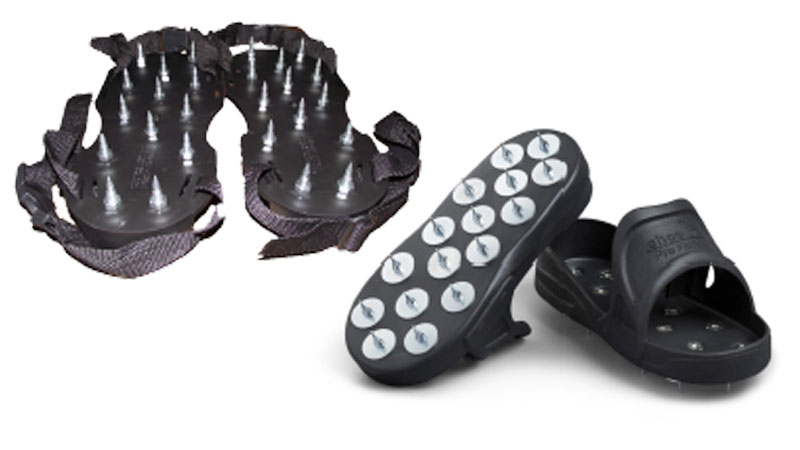
Spiked shoes let you walk across wet epoxy, sealer, or self-leveling material without leaving footprints. The spikes hold your sole above the coating, and the small holes they leave flow back together while the product is still liquid. You need them any time you have to stand in the middle of a fresh coat: back-rolling, broadcasting flakes, working a metallic pour, or fixing a spot you missed.
This guide covers when to wear them, how to match spike length to the coating, how to use and clean them, and what to do when spikes aren’t the right tool.
When you need spiked shoes
On a small floor, you can sometimes roll your way out the door and never step in the coating. Most garages, basements, and commercial floors are too wide for that. Plan on spiked shoes for:
- Back-rolling epoxy and urethane. After you pour and spread the coat with a squeegee, someone has to walk the floor and roll it out evenly.
- Flake and quartz broadcast floors. On a system like Graniflex, you walk into the wet base coat to throw color flakes evenly to the far side of the room.
- Metallic epoxy. Many of the swirls and veins in a Metallic Marble floor are made by hand while the epoxy is wet, so the installer has to stand in it.
- Self-leveling underlayments and overlays. Spikes let you use a spiked roller or gauge rake to knock down ridges and release trapped air.
- Touch-ups during the pour. A missed corner, a drip, a bug, or a hair in the coating can be fixed right away instead of after the floor cures.
How to choose spike length
The rule is simple: the spike has to be longer than the wet material is deep, with some room to spare, so the sole of the shoe never touches the coating. If the sole drags, it leaves a print and lifts material off the floor.
- Thin coatings such as sealers, primers, and roll-coat epoxy are measured in mils (thousandths of an inch). Any standard spike clears them easily.
- Flood coats and metallic epoxy are thicker but still usually well under 1/8 inch. A 3/4 inch spike gives plenty of clearance, and the extra height also keeps the sole clear of flakes and splashes.
- Self-leveling material and thick overlays can run 1/4 inch or more. Check the product’s application thickness and make sure your spikes are clearly longer. Spike lengths of about an inch or more are made for deep pours.
Too long can be a problem too. Longer spikes are less stable, and on a thin coat they add height without any benefit. For most coating work, 3/4 inch spikes are a good all-around size.
Strap-on vs slip-on spiked shoes
There are two common styles, and The Concrete Protector carries both.
Buckle spike shoes strap over your work boots. They are made of durable polypropylene, carry 13 spikes that are 3/4 inch long, and are set up to keep you balanced and stop you from tipping forward on your toes. One size fits all. They are the standard choice for walking on wet epoxies, sealers, and similar products.
Shoe-In spiked shoes slide on without straps, so there is nothing to drag through the coating or break, and no nuts to work loose and drop into the floor. They are easy to get on and off, which helps when you step in and out of a room several times during a job. They come with 3/4 inch metal needle spikes and work for epoxy coatings, overlays, decorative concrete, and self-leveling material.
Whichever style you pick, check the fit before the job. A shoe that slides around on your boot makes you unsteady at the worst time.
How to use spiked shoes on a coating job
- Put them on at the edge of the work area. Stand on a clean piece of cardboard or plastic at the doorway. Walking across a parking lot or a dusty garage in spikes dulls the tips and picks up grit you will then carry into the coating.
- Plan your path. Know where you will start, where you will finish, and how you will get out. Work toward the exit.
- Walk flat-footed with short steps. Lift each foot straight up and set it straight down. Shuffling or twisting drags the spikes and leaves streaks.
- Move while the product is wet. Spike holes only close while the coating can still flow. Once it starts to gel, stay off it. Know the working time of the product before you mix.
- Back-roll over your tracks when needed. On thicker coats, a final pass with the roller or a spiked roller evens out any marks.
- Take them off before you leave the area. Step back onto your cardboard and remove them there.
A safety note: spikes grip well in wet coating but can slide on bare tile, smooth concrete, and metal. Never climb a ladder or walk stairs in spiked shoes.
Cleaning and care
Clean spikes right after the job, before the material cures on them. Cured epoxy is very hard to remove from between spikes.
- For epoxy and urethane, wipe the spikes and sole with the cleanup solvent listed on the product’s technical data sheet, using a rag or stiff brush.
- For water-based sealers and cement-based overlays, rinse with water and scrub with a brush.
- Check each spike. Bent or dull spikes catch and drag. Tighten or replace them as needed.
- Store the shoes so the spikes don’t rest on a hard surface, which bends and dulls them over time.
Alternatives to spiked shoes
Sometimes you can skip them. On a narrow hallway, a closet, or a small bathroom, you can often apply from outside the room and pull the coat toward the door with an extension pole. On a wide floor with a crew, one person can mix while two others work in sections, which shortens the time anyone spends standing in the coat. For thick overlays and cement work, some installers set down kneeboards or planks to reach the middle of a slab. None of these replaces spikes on a full broadcast or metallic floor, but planning the layout ahead of time cuts down how much you have to walk in wet product.
Frequently asked questions
Do spiked shoes leave holes in epoxy?
They leave small holes that close on their own while the epoxy is still liquid. If the epoxy has started to gel, the holes stay, so do your walking early in the working time.
What size spikes do I need for epoxy?
For most floor epoxy, flake, and metallic systems, 3/4 inch spikes give plenty of clearance. Use longer spikes only for deep self-leveling pours.
Can you walk on wet epoxy without spiked shoes?
No. Regular shoes press into the coating, leave prints, and pull material up with each step. They also track it onto the rest of the floor.
Do spiked shoes fit over work boots?
Yes. Buckle-style shoes strap over your boots and are one size fits all. Slip-on styles like Shoe-In slide over your footwear without straps.
How do you clean epoxy off spiked shoes?
Wipe them with the cleanup solvent listed on the product’s data sheet right after the job, before the epoxy cures. Use a stiff brush to get between the spikes.
Get the right gear and the training to use it
You can order spiked shoes from the TCP store along with rollers, squeegees, and the rest of your install kit. For grinders and full equipment packages, see the equipment catalog.
The fastest way to get comfortable working in spikes is to do it with a trainer next to you. TCP’s hands-on epoxy classes in Lima, Ohio include stations for Graniflex and Metallic Marble, with all tools and equipment provided. You can also watch TCP’s training videos, read how long it takes to learn epoxy, or book a consultation to plan your first jobs.